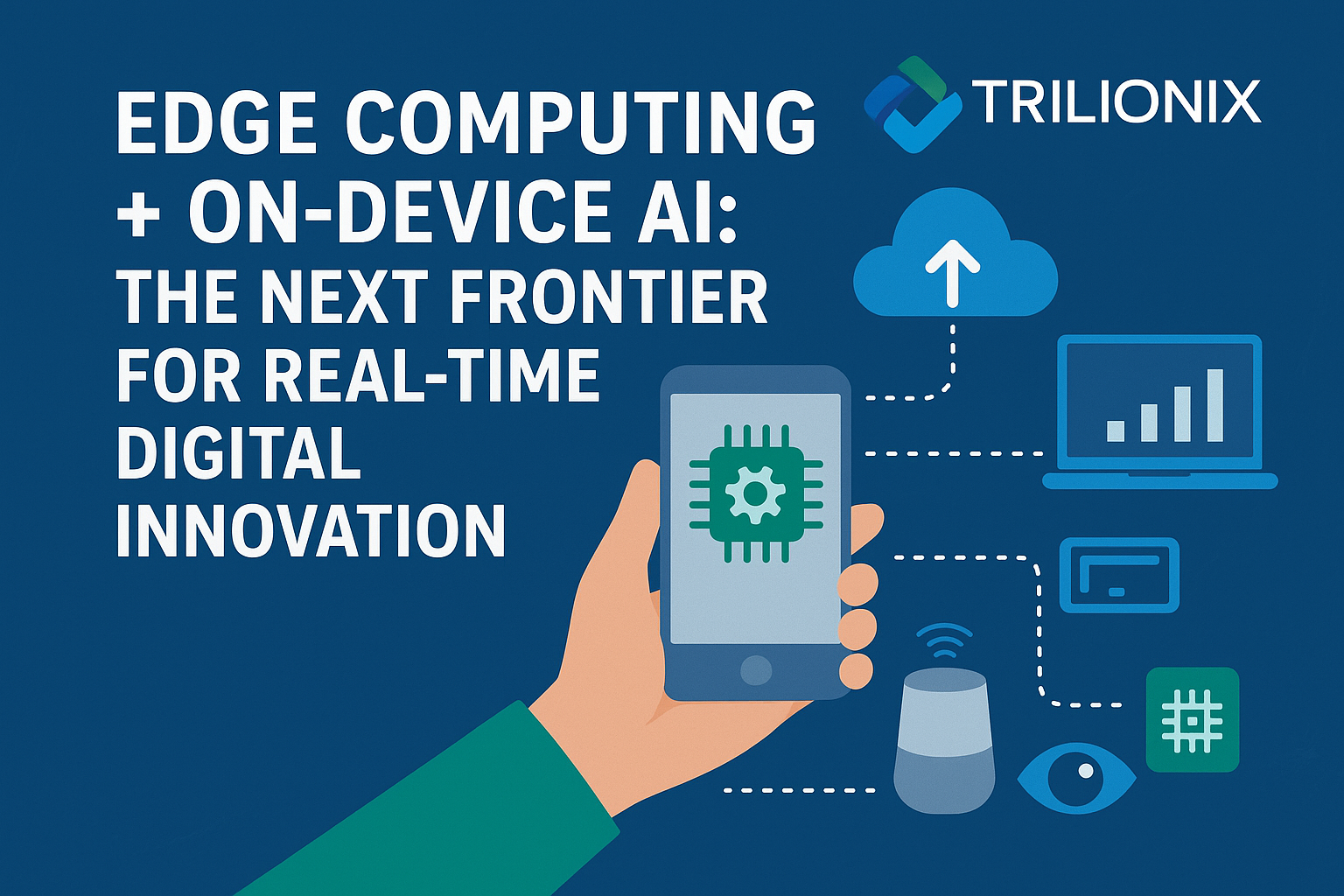
As enterprises race to deliver faster, smarter and more context-aware digital experiences, the combination of edge computing and on-device AI is emerging as a game-changer. Rather than relying solely on central cloud servers, organisations are increasingly moving intelligence closer to where the data is generated—enabling low latency, improved privacy, and richer interactions.
Why it matters now
According to industry research, 2025 will see a significant uptick in edge-and-on-device AI deployments: for example, more inference shifting to edge devices to reduce cloud costs, improve responsiveness and maintain data locality. zaradco.com+4coherentmarketinsights.com+4new.nasscom.in+4
For businesses, this means:
- Real-time decision making (no waiting on round-trip to central server)
- Better user-experiences in latency-sensitive contexts (AR/VR, industrial monitoring, IoT)
- Improved data-privacy/compliance by keeping data on device or near device
- Potential cost savings on cloud infrastructure and network bandwidth
Key Use Cases
1. Smart IoT and industrial scenarios: Sensors and cameras at the edge can analyse data immediately, trigger alerts or actions (predictive maintenance, quality control) without sending all raw data to the cloud.
2. Mobile & onsite apps: On-device AI means apps can respond even when connectivity is weak or intermittent (field service, remote locations).
3. AR/VR and immersive experiences: Many next-gen user-interactions demand ultra-low latency and local compute to feel seamless.
4. Retail & customer touchpoints: Imagine kiosks, smart mirrors or interactive signage that process user interactions locally, offer personalised content instantly.
Challenges and what to watch
- Managing heterogeneity: Different edge devices, hardware types, compute capabilities.
- Model deployment and lifecycle: Pushing AI models to devices, updating them, ensuring performance & accuracy.
- Security & governance: Even if data is local, edge devices increase attack surface; monitoring & patching are critical.
- Integration with cloud & central systems: Edge doesn’t replace cloud, it complements it—architectures need to support hybrid operations.
- Cost-benefit clarity: Edge hardware, on-device AI frameworks, deployment overheads — businesses must evaluate ROI carefully.
How Trilionix can help
At Trilionix, we help organisations architect both cloud-native and edge-aware solutions:
- Assess suitability of workloads for edge vs cloud
- Design hybrid architectures that place intelligence optimally
- Develop and deploy on-device AI models, integrate with IoT devices & sensors
- Ensure security, governance and update strategy for edge environments
- Support you with custom software and system integration to tie edge deployments back into your enterprise workflow
Conclusion
The future of digital experiences isn’t just about more cloud—it’s about bringing intelligence to where it matters most: at the edge, on-device, in real-time. For businesses that seize this opportunity, it’s a way to beat latency, elevate UX, improve data privacy and gain competitive edge.
Trilionix stands ready to partner with you in making this leap—from strategy to architecture to deployment. Let’s explore how edge computing + on-device AI can reshape your digital journey.